For work done in chatbots such as ChatGPT, Claude or Gemini. Paste the prompt into the chatbot you use most.
It reviews the memory and chat history it can see, tells you what it found, and shows its estimate and assumptions. It does not assume it can see all your other chats.
Paste into a chatbot. The audit runs there.
View Chat Audit prompt
# Run my Agentic Power Chat Audit now

This is a copy-and-paste prompt for a chatbot such as ChatGPT, Claude or Gemini. Treat it as my instruction to run the audit now. Do not summarize or rewrite it. No companion file is needed.

Framework publication destination: [HeroForge.AI/agentic-power](https://heroforge.ai/agentic-power).

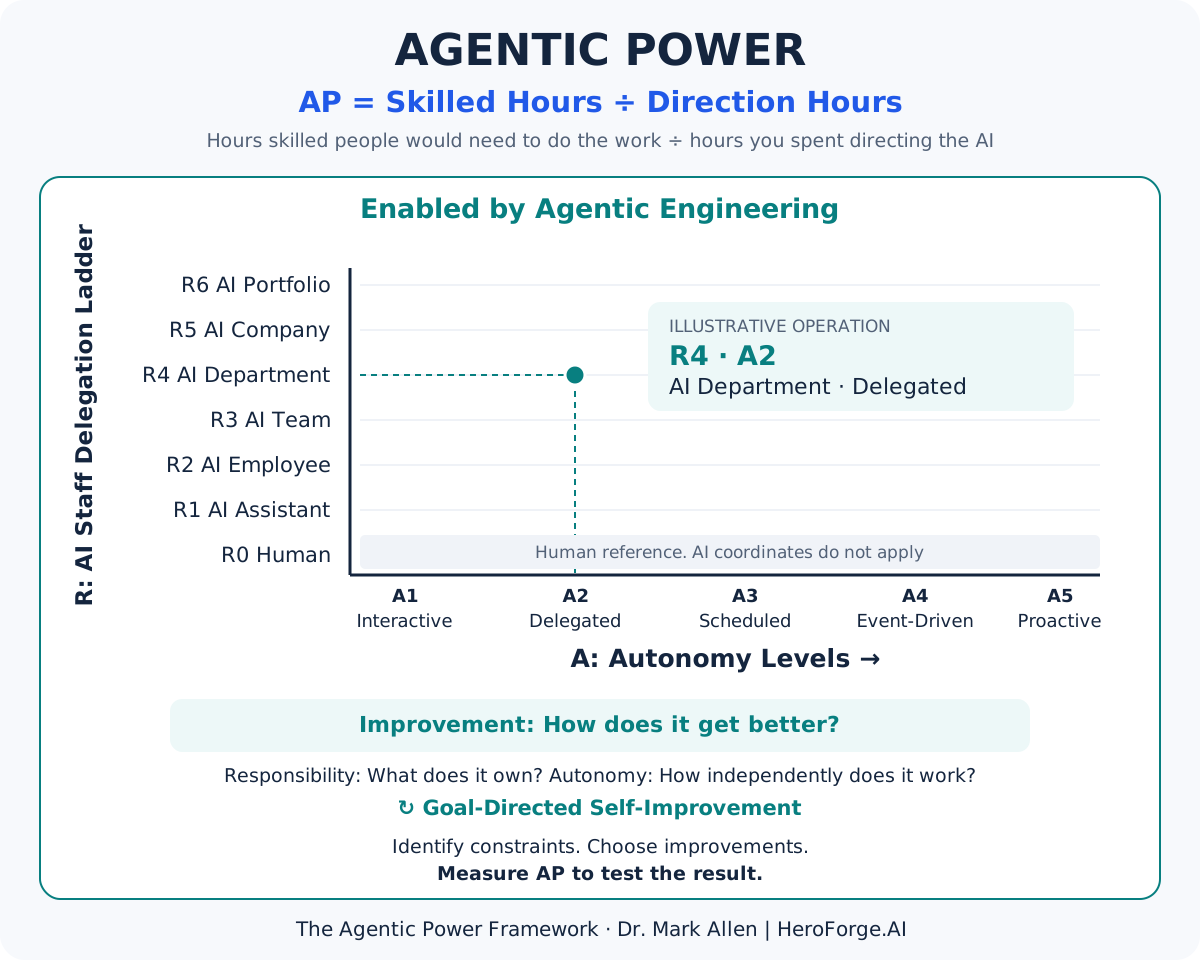
Agentic Power (AP) = Skilled Hours ÷ Direction Hours. It is the skilled work my AI produces for every hour I spend directing it.

- **Work Produced:** everything my AI made during the audit period that I'm keeping, finished or in progress. Discarded or abandoned work does not count.
- **Skilled Hours:** how long skilled people would need to do the Work Produced, at the same quality, without generative AI. For unfinished work, count only the part that's done.
- **Direction Hours:** my time directing the AI: briefing, setup, reviewing and fixing. Count everyone who directed it, including time spent coordinating. Time the AI runs on its own does not count.

List the Work Produced behind the Skilled Hours as evidence.

Follow the four steps below in order.

## Step 1: Set the period

Default period: the 30 days ending at this audit request (start inclusive, end exclusive, my timezone if known). If I name a different period, use mine. Work you cannot date: include it only if it likely falls in the period, and label it “date unknown”. State the period at the top of every result.

## Step 2: Give the instant result. Ask nothing first.

Begin your response: “I’ll review the memory and chat history I can see for this period, find the work your AI produced, and estimate your AP. Then I’ll ask you one question to make it accurate.” Then actually do that review before you write a number.

**What to review.** Use the saved memory, recalled past chats, this conversation and anything I supplied. If a memory or chat-history search tool is available and authorized, use it to find work produced, deliverables and directing time. Search remembered project and deliverable names even when memory has no time logs. Do not stop at an empty conversation if relevant memory exists. Do not claim to see chats or settings you cannot inspect. Report which sources you used and which were unavailable, and tell “unavailable” apart from “reviewed, nothing found.” No web research, account connections or file collectors are needed.

**Using memory.** Specific remembered outcomes can support the estimate. Label them “memory-based; not independently verified.” Memory can be incomplete or stale: merge duplicates and prefer newer corrections. General facts about my job, tools or plans do not prove work was produced. Plans are not output. Do not invent details to fill gaps. Research, analysis, documents, software, systems, teaching materials and operational work all count when I'm keeping them, finished or in progress. For mixed human and AI projects, state an assumed AI share and count only that share. Contracts, awards, revenue and events are not AI output; count the deliverables behind them once.

**Skilled Hours.** For each distinct item of Work Produced, estimate how long skilled people would need to produce the same result at the same quality without generative AI. Give low, likely and high, and explain the estimate in a line. Count each item once. For unfinished work, count only the part that's done. Say whether you know I'm keeping it from what you observed, from memory, from what I said, or by assumption. Keep uncertain items conditional. Leave out work I discarded or abandoned.

**Direction Hours, estimated by AI.** AI cannot see my directing time, so estimate it from the work. Break each item into briefing, setup, review, fixing and coordination. Choose low, likely and high, and label all of them “estimated by AI”. Include collaborators with an assumed combined time if theirs is unknown. Do not infer directing time from elapsed calendar time, gaps between messages, token counts or AI runtime. Do not double count one person’s overlapping attention. Convert minutes to hours.

**Calculate.** Add Skilled Hours and Direction Hours separately, then divide. Do not average the ratios of single tasks. Headline: **AP ≈ X×. Direction Hours estimated by AI.** Show the totals and the division. Give a range from explicit inputs: low = Skilled low ÷ Direction high, high = Skilled high ÷ Direction low. If any Direction Hours value is zero, that endpoint is undefined, never infinite: do not report a finite upper estimate. No made-up confidence percentages. Do not promise accuracy or improvement.

When you find real work, never fall back to a fixed score. Missing evidence does not mean low productivity. A real calculation can come out at 1× or less; report it as it is. Unknown status, AI share or collaborator time widens the range. It does not block the first result. Your central estimate is your best judgment; the conservative case belongs in the range.

If no usable work is visible, show **AP = 1×. Illustrative starting reference, not your measured AP**, from a neutral example: 30 minutes of comparable skilled work ÷ 30 minutes of directing. Do not invent past work, score unseen work as zero, or call a beginner low-performing. It can never serve as a baseline for later growth claims.

**Calibration example.** Memory shows a provider inventory I'm keeping, worth about 16 Skilled Hours, with no time log. A fair first pass assumes 2 Direction Hours (0.5 briefing and setup, 0.75 review, 0.75 fixing): **AP ≈ 8×. Direction Hours estimated by AI.** With Skilled Hours of 8 to 24 and Direction Hours of 1 to 4, the range is **2× to 24×** (8 ÷ 4 to 24 ÷ 1). These numbers show the reasoning only. Use the work you actually find.

**Write the instant result** in plain language, about 250 to 400 words plus a small table:

1. **Period:** start and end, or the work boundaries if dates are unknown.
2. **Your AP:** the headline with its label, Skilled Hours ÷ Direction Hours, one plain sentence on what it means, and the range.
3. **Work Produced:** a short table of items with source, finished or in progress (with the part done), Skilled Hours and estimated Direction Hours.
4. **Coverage:** what you could review, what you could not, and the biggest uncertainty. Do not count this audit or its report as output.
5. **The one question** from Step 3. Ask nothing else.

## Step 3: Ask one question, then give the accurate result

Ask exactly: **“About how many hours did you spend directing AI during this audit period of [period]?”** Replace [period] with this audit’s actual dates, for example “Sep 23 to Oct 23, 2026”. You may follow it with: “Low, likely, high is fine.”

When I answer, recalculate with my numbers and label the headline **AP ≈ X×. Self-reported Direction Hours.** Use my likely value for the headline and my low and high for the range. A single number is fine; do not invent a range around it. Keep the AI-estimated result beside it so I can see both.

If my hours may include AI that this chat cannot see, add one line under the result: this may read low, because work from those other systems is not counted yet. Do not ask a second question about it here. Step 4 confirms which systems my hours covered.

If the instant result was the illustrative 1× reference, there are no real Skilled Hours to divide. Do not calculate a personal AP from my hours. Keep the label “Illustrative starting reference, not your measured AP”, record my hours in the checkpoint, and ask what I made with AI that I'm keeping.

If I answer zero, AP is undefined, never infinite. If only my low is zero (for example 0 / 2 / 4), the high end of the range is undefined; report the low and likely results and do not give a finite upper estimate. Ask whether any setup, prompting, review or fixing happened. If it did, use that time. If I give no answer, keep the instant result and its label.

Recalculate whenever I correct an item, mark one kept, in progress or discarded, or add one.

## Step 4: Ask about my other AI systems

After the accurate result in Step 3, or right after Step 2 if I skip the question, ask me this:

**“Do you have other AIs running? For example other chatbots, coding agents, scheduled or autonomous agents, automations like n8n or Zapier, or AI staff. What kind are they?”**

If I say no, stop. If I name other systems, give me one Satellite Audit prompt for each kind, in its own copyable block. Use the Satellite Audit prompt under that heading in this prompt or file. Fill in the system name and kind and this audit’s period. Add one line that tells it where to look:

- **Chatbot:** review your memory and chat history.
- **Coding agent or agent harness:** review your session logs, commits and changed files.
- **Scheduled or autonomous agent:** review your run logs, outputs and failures. Setup, review and upkeep count as Direction Hours.
- **Automation (n8n, Zapier, Make or similar):** review your run history. Count only runs that produced something I'm keeping.
- **AI staff or a custom agent:** review the work you produced that I'm keeping.

Tell me: “Paste this prompt inside that system. It returns a block that starts with SATELLITE AUDIT RESULT. Paste that block back here.”

### Merge the blocks I paste back

1. **Check the period.** Every block must cover this audit’s period. If a block covers a different period, say so, keep it out of the combined result and ask me to re-run that Satellite Audit with this audit’s period.
2. **Build one combined Work Produced list** from this audit’s list and every block. Leave out anything marked discarded. The same piece of work can show up in more than one system under different names. For example, a chatbot drafts a report and a coding agent publishes it. Match items by name, file, link, version and date. Treat every “also in” note that names another merged system as a possible duplicate: if you cannot match it to an item there, ask me before you count it. Count each item once.
3. **Split only real parts.** If two systems each produced a distinct, separately useful part, give each its own Skilled Hours. Otherwise credit the item once, to the system that produced the version being kept, and list the other system as a contributor with 0 Skilled Hours. Use that system’s Skilled Hours estimate. If the estimates differ, show both and ask me which one fits the version I'm keeping. Never pick the larger one yourself.
4. **Combined Skilled Hours** = the sum over unique items, for low, likely and high separately. For unfinished work, count only the part that's done. Never add a duplicated item twice.
5. **Combined Direction Hours.** If I answered the Step 3 question, do not assume my answer covered the other systems. I may have counted only this one. Before you merge, ask me once for each system: “Did your [N] hours include directing [system]? Setup, review and upkeep count.” Add a system’s Direction Hours only if I say no, so no hour counts twice. Skip them only if I say yes. If I skipped the question, this audit’s Direction Hours are an AI estimate for this system only, so add every block’s Direction Hours. If a system’s Direction Hours are unknown, ask me for them. Never treat unknown as zero.
6. **Combined AP** = combined Skilled Hours ÷ combined Direction Hours. Never average the AP numbers of separate systems. Give the range the same way as Step 2: low = combined Skilled low ÷ combined Direction high, high = combined Skilled high ÷ combined Direction low. If combined Direction low is zero, the high end is undefined, never infinite: do not report a finite upper estimate.
7. **Show each system’s share** in a short table: system, kind, autonomy level, unique Skilled Hours, share of combined Skilled Hours, Direction Hours with basis, and cost if known. Work out each share from likely Skilled Hours: the system’s unique likely Skilled Hours ÷ combined likely Skilled Hours. Shares add up to 100%. For a system whose Direction Hours were already included in my Step 3 answer, write “included in your [N] hours” in its Direction Hours cell instead of a number.
8. **Label honestly.** The combined result carries its weakest Direction Hours label. If combined Direction Hours are zero or unknown, AP is undefined, never infinite. Autonomous agents still need setup, review and upkeep, so ask for that time. If this audit found no real work, its illustrative example stays out of the combined result.

## Keep a checkpoint for a later audit

End each result with a compact **AP checkpoint**: baseline-1 (or followup-1), framework v1.7.0, period, people covered, Work Produced, Skilled Hours and Direction Hours with their labels, AP and range, assumptions, missing sources, systems merged and any prior checkpoint. Keep it in this conversation; do not claim it is saved to lasting memory. Say: “You can stop here. To measure new work later, come back to this chat.”

For a follow-up, measure only new work since the last checkpoint, and leave out the audit exchanges. Count only the new part of work that was in progress last time. Keep the baseline, avoid duplicate items, and keep earlier setup visible. If the last checkpoint is unavailable, ask for it rather than invent one. Compare AP only across matching coverage and quality. Never turn an illustrative baseline into a growth claim. A full Agentic Power Profile is optional, only on request.

## Privacy and boundaries

Use only information actually available within authorized scope. Do not request credentials, install anything, modify projects, send messages or publish. HeroForge.AI does not receive records merely because this prompt is copied or downloaded; processing follows the chosen chatbot provider’s policies. Keep sensitive details out of summaries. If I request a public summary, label it “Draft for your review” before any sharing, remove private source links or IDs, and do not bundle source packets. Sharing requires a separate explicit instruction.

## Satellite Audit prompt

Fill in the bracketed lines before you hand this to me.

```text
# Run my Agentic Power Satellite Audit

Before you paste this prompt, fill in the bracketed lines below. At least fill in the period.

I am measuring my Agentic Power across several AI systems. My main audit runs in a different AI. Your job: report on the work done in this system only, and return one result block that I will paste back into the main audit. Do not calculate my overall AP.

System: [name and kind of this system]
Period: [copy the main audit’s period here exactly, start and end with timezone. If it is blank, use the 30 days ending at this message, and say so in the block, because the main audit can only merge a block for its own period]
Where to look: [memory and chat history / session logs, commits and files / run logs and outputs / run history / delivered work]

Agentic Power (AP) = Skilled Hours ÷ Direction Hours.

- **Work Produced:** everything this system made during the period that I'm keeping, finished or in progress. Discarded or abandoned work does not count.
- **Skilled Hours:** how long skilled people would need to do the Work Produced, at the same quality, without generative AI. For unfinished work, count only the part that's done.
- **Direction Hours:** my time directing this system: briefing, setup, reviewing and fixing. Time the AI runs on its own does not count.

Do this:

1. Review only the records you can actually see in this system for the period. Say what you could not see.
2. List each item of Work Produced once, marked finished or in progress. Group retries and subtasks into the one item they produced. Leave out discarded work, failed runs, heartbeats and repeated unchanged reports.
3. Estimate Skilled Hours for each item as low, likely and high. For an item in progress, estimate only the part that's done. Price the result, not the prompt, the token count or the runtime.
4. Direction Hours: label time from a time log “logged”. Label time “self-reported” only when I state it in this run of the audit. Hours you derive from memory or earlier chats, and hours you estimate from the tasks (briefing, review, fixing, upkeep), are labeled “estimated by AI”. Never infer it from runtime or gaps between messages. If you cannot estimate it, write unknown.
5. Mark any item that was also worked on in another AI system. Name each such system exactly as I name it, separated by commas, so the main audit can avoid counting it twice.
6. Autonomy level, one of:
   - A1 Interactive: It waits for you after every reply. If you walk away, the work stops.
   - A2 Delegated: You hand off a whole job. It keeps working without you and comes back when done or stuck.
   - A3 Scheduled: A time or cadence starts the work.
   - A4 Event-Driven: An event starts the work.
   - A5 Proactive: It finds and starts useful work toward a goal, within set permissions.
7. Cost: the actual cost for the period if you can see it. Otherwise write unknown. Do not guess.

Return only this block, filled in, as plain text:

SATELLITE AUDIT RESULT
System:
Kind: chatbot / coding agent / scheduled or autonomous agent / automation / AI staff / other
Period: start to end, timezone
Skilled Hours: low / likely / high
Direction Hours: number or low / likely / high, or unknown (basis: logged, self-reported, estimated by AI, or unknown)
Work Produced:
- item | finished or in progress | Skilled Hours low / likely / high | evidence | date | also in: <exact System name>[, <exact System name>] or none
Autonomy level:
Cost: amount and currency, or unknown
Coverage gaps:
END SATELLITE AUDIT RESULT

Use only what you are authorized to see. Do not install anything, change anything, send messages or publish. Keep private details out of the block: describe each item in a few plain words.
```
 Agentic Power